
The deep sea is full of bizarre and extraordinary creatures, deep down where the pressure is high, away from human intervention, with freezing cold temperatures and complete darkness—a habitat for many wonderful creatures that manage to survive and thrive there.
For example, the one-of-a-kind, elusive bigfin squid. It’s very unlikely to encounter one of these squids; only about 20 recorded sightings exist in as many years. This means there’s a lot we aren’t aware of, and a significant lack of knowledge about this magnificent deep-sea creature.
Bigfin squid are in the genus Magnapinna, which means “great fin” in Latin. They get their name from the fact that their fins stretch to about 90% of the length of the mantle (the main body) of the squid. The largest bigfin squid on record stretched to more than 20 feet long, and it’s possible they can grow even larger. Bigfin squid are the deepest-living squids we know of—they can live at depths of more than 20,000 feet (6,000 meters).
Their arms and tentacles are disproportionately long compared to body size. Like every other squid, they have 8 arms and 2 tentacles, but in bigfin squid, you can’t tell the two apart. Instead, all 10 hang down from their bodies. Some scientists speculate that they use their arms and tentacles as a spiderweb-like net to capture small prey as it swims by. They also suspect that the odd angle (about 90°) of their arms and tentacles—which some have compared to elbows—helps ensure the long appendages don’t get tangled.
Bigfin squid were only officially described by scientists in the 1980s. Michael Vecchione, a research zoologist at NOAA and the Smithsonian, and Richard E. Young, a cephalopod specialist from the University of Hawaii, come into the story. In 1998, these two researchers pulled together scattered juvenile specimens and realized they belonged to a previously unrecognized squid family, which they named Magnapinnidae—the family that includes the bigfin squid. They even described a new species, Magnapinna pacifica, as the first official member of the group.
The first specimen was caught in the early 1900s, but the individual was damaged, and scientists couldn’t easily identify it. They eventually classified it as a different type of cephalopod called a whip-lash squid. Many decades later, five more specimens were collected in the Atlantic and Pacific, and researchers were able to connect these new samples to the old specimen. Interestingly, all these specimens were juveniles—it wasn’t until the use of undersea remotely operated vehicles that scientists were able to observe an adult bigfin squid.
The bigfin squid reminds us that the deep sea is full of mysteries—far below the light, in the silent darkness, countless creatures may be swimming that humans have never seen, living their lives in peace and harmony. It’s a world untouched, a reminder that even on our crowded planet, the unknown still reigns.
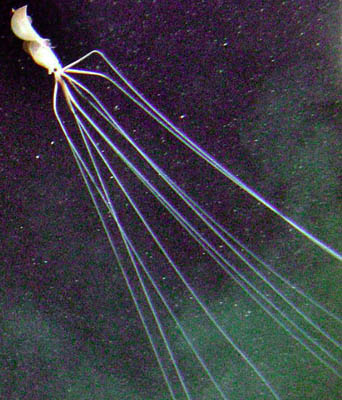
"Squid with ten foot tentacles seen at 1900 m on dive 3633 at Atwater Valley site. courtesy: Andy Shepard